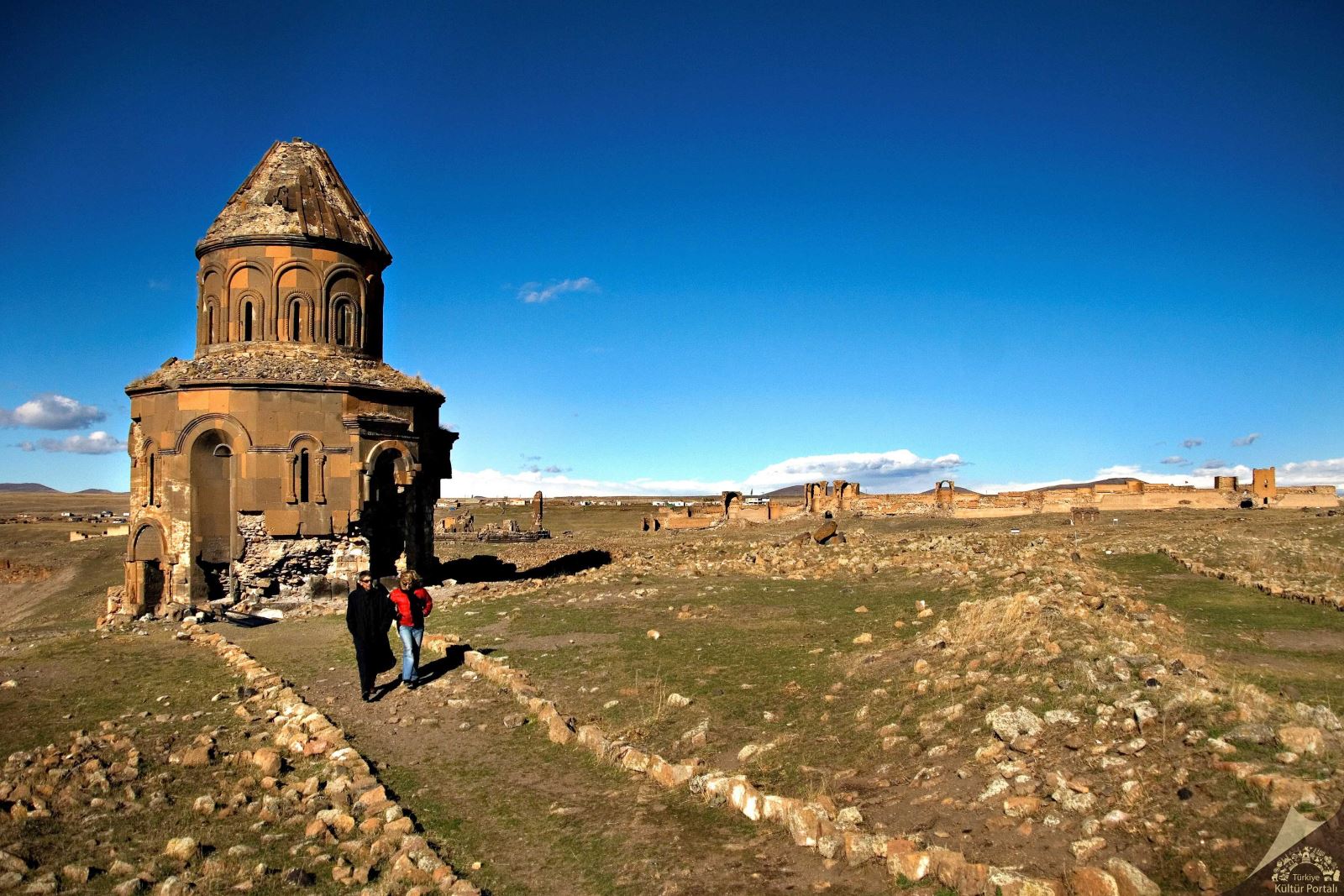
Ani is a medieval city southeast of Kars, in the valley of the Arpaçay River. As the capital of the Bagratuni Armenian Kingdom, it experienced its golden age in the 10th-11th centuries; its position on the Silk Road turned it into a trade and cultural center capable of rivaling contemporary Constantinople, Baghdad, and Cairo. Its population is estimated to have exceeded 100,000 at its peak.
The city was known as the "City of 1001 Churches" for its countless churches and chapels. It was conquered in 1064 by the Seljuk Sultan Alp Arslan; the great cathedral was converted into a mosque at that time and named the "Fethiye Mosque." Following Mongol invasions and earthquakes, the city was gradually abandoned. The Ani Archaeological Site was inscribed on the UNESCO World Heritage List in 2016.
Highlights
Great Cathedral (Fethiye Mosque)
A cathedral of red tuff stone built by architect Trdat, who also carried out repairs on the Hagia Sophia in Istanbul.
Tigran Honents Church
Built in 1215, decorated with rich frescoes depicting biblical scenes and the life of St. Gregory — one of the best-preserved structures.
Manuchihr Mosque
Built in 1072, considered one of the first Turkish mosques in Anatolia.
Multicultural architecture
Armenian churches, a Seljuk mosque, and a Zoroastrian fire temple stand side by side in the same city.